Back to List
Note: ①This article is compiled from online information; please use discretion. ②If any errors are found, corrections are welcome. ③For a more comprehensive and systematic understanding of geosynthetics, please refer to professional and authoritative materials for product information and application knowledge.
1. Hazards of Lateral Deformation and Outward Expansion of Fill Subgrade
Lateral deformation and outward expansion of fill subgrade lead to a series of problems:
- Slope bulging and deformation. The subgrade slope surface bulges outward locally, losing its straight alignment and affecting stability.
- Toe heave and displacement. Soil at the slope toe is squeezed out, heaving and moving outward, destabilizing the subgrade edge and damaging protection works.
- Pavement cracking and stepping. Lateral deformation reflects on the pavement as longitudinal cracks and faulted steps; rainwater seeps through the cracks, accelerating subgrade damage.
- Damage at junction zones. Deformation concentrates at connections between fill subgrade and old roadbed, bridges, culverts, and retaining walls, causing differential settlement and cracks.
- Overall instability and slumping. As lateral deformation continues, the subgrade loses overall sliding resistance and eventually slumps or slides, scrapping the project.
- High repair costs. Without root treatment, pavements crack again after repair and slopes bulge again after patching, with repeated investment far exceeding one-time treatment costs.
2. Causes of Lateral Deformation and Outward Expansion
The causes of lateral deformation and outward expansion are multifaceted, mainly from the following aspects:
(1) Substandard fill material
Fill soil with high mud content, high moisture content, or excessive organic matter has low strength and poor resistance to lateral deformation. Substandard fill makes the subgrade inherently unstable.
(2) Insufficient compaction
Inadequate layer-by-layer rolling leaves the fill loose and under-densified; the subgrade continues to compress and squeeze laterally under self-weight and traffic loads. Without proper compaction, no measure can hold the subgrade together.
(3) High fill height
The higher the fill, the greater the self-weight and the greater the lateral stress at the slope toe, intensifying outward expansion. High embankments are the most affected zones.
(4) Inadequate foundation bearing capacity
Weak foundations cannot bear the fill load, and lateral extrusion of the foundation drags the upper subgrade outward. Without foundation treatment, even dense subgrade fill fails.
(5) Over-steep slope angles
Excessively steep design slopes lack stability reserve, and slope soil slides outward under self-weight and rainwater, causing lateral deformation.
(6) Poor drainage
Rainwater seeps into the fill, raising moisture content and reducing soil strength, aggravating lateral deformation. Poorly drained sections suffer more severe problems.
3. How Geogrid Reinforcement Works
Geogrid reinforcement is a mainstream approach to controlling lateral deformation of fill subgrade, with clear working principles:
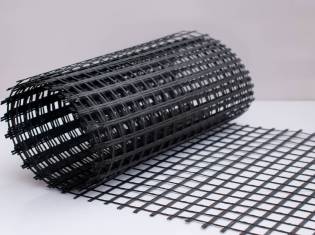
- Interlocking restraint of lateral displacement. Embedded in fill, the geogrid interlocks with soil through its apertures, linking loose particles into a whole and restraining lateral displacement under load.
- Stress distribution and transfer. The tensile strength of the geogrid transfers tensile stresses within the subgrade over a wider area, reducing stress concentration and localized deformation.
- Layered reinforcement for integral action. Layered geogrids form reinforcement layers within the subgrade, spreading vertical loads over a wider base and reducing lateral stress at the toe, transforming the subgrade from "loose piled soil" into an "integral reinforced body".
- Coordination with foundation treatment. For weak foundations, geogrids work with replacement or stabilization measures to jointly control foundation settlement and lateral extrusion.
- Improved slope stability. Geogrids laid and anchored near the slope surface restrain outward sliding of slope soil and improve overall slope stability.
4. Common Construction Pitfalls
Several pitfalls in fill subgrade reinforcement can undermine the treatment effect:
- Arbitrary geogrid selection. Different fill heights and foundation conditions require different geogrid strengths and moduli. Too low cannot control deformation; too high wastes cost.
- Insufficient reinforcement layers. Missing designed layers or excessive layer spacing provide insufficient restraint, and lateral deformation continues.
- Substandard fill and compaction. With unqualified fill and inadequate compaction, geogrid reinforcement cannot hold loose soil, and the reinforcement effect is meaningless.
- Inadequate overlap and anchoring. Too-short overlaps and weak end anchoring cause overlaps to open under load, defeating the entire reinforcement.
- Missing slope protection. Reinforcement inside the subgrade without supporting toe and slope protection still allows toe heave and outward expansion.
- Untreated foundation. Placing reinforcement directly on weak foundations allows foundation lateral extrusion to drag the subgrade outward, wasting internal reinforcement.
5. Common Owner Concerns
Owners of fill subgrade reinforcement projects typically have these concerns:
- Whether deformation remains uncontrolled after reinforcement, with continued settlement and expansion after opening, high repair costs, and disrupted use.
- Whether geogrid materials are substituted with substandard products, casting doubt on reinforcement performance.
- Whether concealed works are done to standard; invisible links such as layer count, overlaps, and anchoring cannot be seen on the surface and only emerge later.
- Whether the reinforcement process delays the overall schedule with added filling, reinforcement, and compaction procedures.
- Unclear responsibility when materials, construction, and design are contracted separately, leading to disputes.
These concerns are resolved through well-founded design and process acceptance. With basis for the plan, records for construction, and testing for acceptance, the reinforcement effect is guaranteed.
6. Overall Reinforcement and Treatment Plan
Reinforcement of fill subgrade lateral deformation requires integrated planning and systematic treatment, implemented in the following steps:
(1) Geological and condition assessment
Before construction, investigate fill height, fill properties, foundation conditions, and groundwater, assess lateral deformation risk, and determine reinforcement layer count, geogrid parameters, and treatment depth. The plan must be based on survey data, not guesswork.
(2) Weak foundation treatment
For insufficient bearing capacity, replace or stabilize the foundation first to seat the base and prevent foundation lateral extrusion from dragging the subgrade outward. Foundation treatment is the basis of reinforcement.
(3) Layered geogrid installation
Lay geogrids in the designed number of layers with compacted fill between layers. Lay flat, tension, and fix the geogrid; overlaps and end anchoring must meet specifications to form an integrated reinforced structure.
(4) Fill and compaction control
Use qualified fill material, place and compact in lifts, and verify compaction of each layer before placing the next. Fill and compaction are the foundation for reinforcement to work and cannot be skipped.
(5) Coordinated slope protection
Provide toe protection and slope surface protection in coordination with internal reinforcement to prevent toe heave and surface erosion, controlling deformation both internally and externally.
(6) Process inspection and acceptance
Inspect geogrid placement, overlaps, and compaction layer by layer during construction, keep acceptance records, and carry no hidden defects into the next process.
7. Value of Turnkey Material-and-Labor Contracting
For projects with high technical requirements and tight material-construction integration like fill subgrade reinforcement, a turnkey material-and-labor package is a reliable approach:
- Integrated plan. From geological assessment, geogrid selection, layered installation to slope protection, one team follows a unified plan with materials matching construction.
- Reliable materials. The turnkey contractor is responsible for geogrid and other materials, ensuring specifications and strength meet requirements without cutting corners.
- Standardized construction. Layered reinforcement, overlaps, anchoring, and compaction follow specifications, with process acceptance records for guaranteed reinforcement quality.
- Controllable schedule. Material supply and site construction are coordinated together, avoiding delays from material or process mismatches.
- Single point of responsibility. The turnkey contractor is fully responsible for reinforcement quality, so the owner does not coordinate between materials and construction.
- Lower total cost. Doing it right once avoids repeated deformation and repeated repairs, making the overall cost lower.
Lateral deformation and outward expansion of fill subgrade are visible problems with hidden risks; waiting until the slope visibly bulges is too late. Choosing the right reinforcement approach, executing layered construction properly, and supervising concealed works carefully control lateral deformation from the root.