Back to List
Note: ①This article is compiled from online information; please use discretion. ②If any errors are found, corrections are welcome. ③For a more comprehensive and systematic understanding of geosynthetics, please refer to professional and authoritative materials for product information and application knowledge.
1. Common Symptoms of Water Accumulation and Backflow on Low-lying Sites
Low-lying sites commonly face these problems during rainy seasons:
- Large-scale site water accumulation. After heavy rain, water cannot drain away, and the site remains submerged for long periods, disrupting normal operations.
- Water backflow into buildings. Water levels rise above thresholds and entrances, causing rainwater to flow back into factories, warehouses, and basements.
- Excavation pits flooded. Construction pits cannot drain fast enough and are filled by rainwater, delaying construction progress.
- Surrounding runoff convergence. Rainwater from surrounding higher ground flows into the low-lying site, turning it into a temporary reservoir.
- Soil softening and settlement. Prolonged soaking weakens the soil, causing ground settlement and affecting building foundations.
2. Causes of Water Accumulation and Backflow
The causes of water accumulation and backflow on low-lying sites typically include:
- Naturally low terrain. The site elevation is lower than surrounding areas, making it a natural catchment zone where surrounding rainwater flows in.
- Insufficient drainage capacity. Site drainage ditches and pipe networks lack design capacity, or are aged and blocked, unable to handle heavy rain.
- Lack of seepage isolation. The site has no impermeable layer, so rainwater seeps into the soil, or groundwater rises through weak points and backflows.
- Missing flood protection structures. The site lacks flood walls, flood boards, or raised entrances, so rainwater flows directly into buildings.
- Lack of emergency drainage. No emergency pumping measures exist during heavy rain, so water can only dissipate by natural infiltration and evaporation, draining slowly.
3. Role of Geomembrane Seepage Control on Low-lying Sites
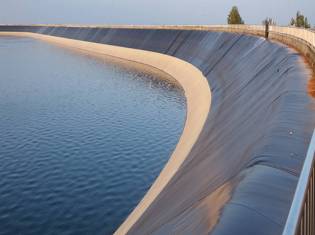
Geomembrane is the key material for seepage control and backflow prevention on low-lying sites. Its functions include:
- Blocking downward infiltration. A geomembrane layer in the site foundation blocks rainwater and groundwater from seeping down, preventing soil softening and settlement.
- Isolating groundwater. The floor slab and side walls are isolated with geomembrane, keeping groundwater outside the structure and preventing upward backflow.
- Protecting building foundations. The membrane separates water from foundations, reducing water erosion and damage.
- Combining with drainage for integrated protection. Geomembrane seepage control combined with a drainage system keeps water out and prevents it from staying.
Proper geomembrane layout is one of the fundamental measures for backflow prevention on low-lying sites.
4. Common Construction Pitfalls
Several common mistakes make seepage control work ineffective:
- Drainage only, no seepage control. Installing drainage ditches without an impermeable layer still allows rainwater to seep down and backflow.
- Arbitrary geomembrane selection. Choosing the wrong thickness for site loads and groundwater pressure means the membrane cannot withstand the conditions.
- Poor seam treatment. Seams not properly welded allow water to penetrate through, rendering the impermeable layer useless.
- Insufficient up-turn height. The membrane up-turn at site edges and building walls is too low, allowing water to flow over the top.
- No protective layer. The membrane is not protected and gets punctured during backfilling, causing seepage control failure.
- Blocked drainage outlets. Drainage outlets remain blocked even after seepage control is done, so water still cannot drain away.
5. Common Owner Concerns
Owners of low-lying site seepage control projects typically worry:
- Whether water accumulation will still occur after renovation if seepage control and drainage are not coordinated.
- Whether construction will disrupt production during excavation and backfilling.
- Whether the investment is large with little visible benefit.
- Whether the work will be completed before the rainy season.
- Who is responsible when design, materials, and construction are contracted separately.
6. Overall Implementation Methods
Seepage control and backflow prevention on low-lying sites require integrated planning and systematic implementation:
(1) Site assessment first
Before the rainy season, assess the site elevation, catchment area, groundwater level, and current drainage conditions to evaluate the risk level of water accumulation and backflow, then determine the seepage control and drainage plan.
(2) Coordinate seepage control and drainage
Design the geomembrane impermeable layer together with site drainage ditches, collection wells, and emergency pumping, so water cannot enter, cannot stay, and drains quickly.
(3) Proper node treatment
Pay special attention to site edges, building wall bases, and pipe crossings. The membrane up-turn height must meet requirements, seams must be properly welded, leaving no seepage paths.
(4) Supporting flood protection measures
Install flood boards at building entrances, and set flood walls or raised thresholds around the site to keep water outside buildings.
(5) Emergency drainage provisions
Reserve emergency pump positions and power supply so that water can be pumped out quickly during heavy rain, minimizing losses.
(6) Acceptance before the rainy season
Complete the renovation before the rainy season and conduct water storage or storm simulation tests to confirm seepage control and drainage performance before putting the site into use.
7. Value of Turnkey Material-and-Labor Contracting
Seepage control renovation on low-lying sites involves site assessment, plan design, material selection, seepage control construction, and drainage support. A turnkey material-and-labor package from a professional team offers clear advantages:
- Integrated plan. Seepage control, drainage, and flood protection are designed together rather than piecemeal.
- Reliable materials. Geomembrane specifications are selected according to site conditions, and seam construction follows standards, ensuring seepage control performance.
- Controllable schedule. A professional team coordinates the process and completes the work before the rainy season.
- Single point of responsibility. The turnkey contractor is responsible for seepage control quality, saving the owner from coordination.
- Lower total cost. Doing it right once avoids repeated investments from flooding every rainy season.
For water accumulation and backflow on low-lying sites, waiting until the rainy season to take action is too late. Implement comprehensive seepage control and backflow prevention measures before the rainy season for one-time investment and long-term peace of mind.